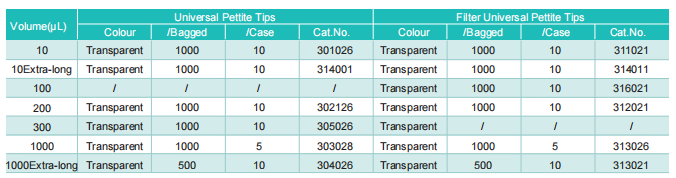
In biological experiments, precise transfer of small-volume samples directly affects data reliability and reproducibility. Recently, several creators on social media shared their experiences using NEST low-binding tips. Their feedback shows that these tips provide significant advantages across various experimental scenarios.
NEST low-binding tips help reduce enzyme and antibody waste, minimize loss of precious samples, and ensure more accurate experimental results.

Real User Feedback
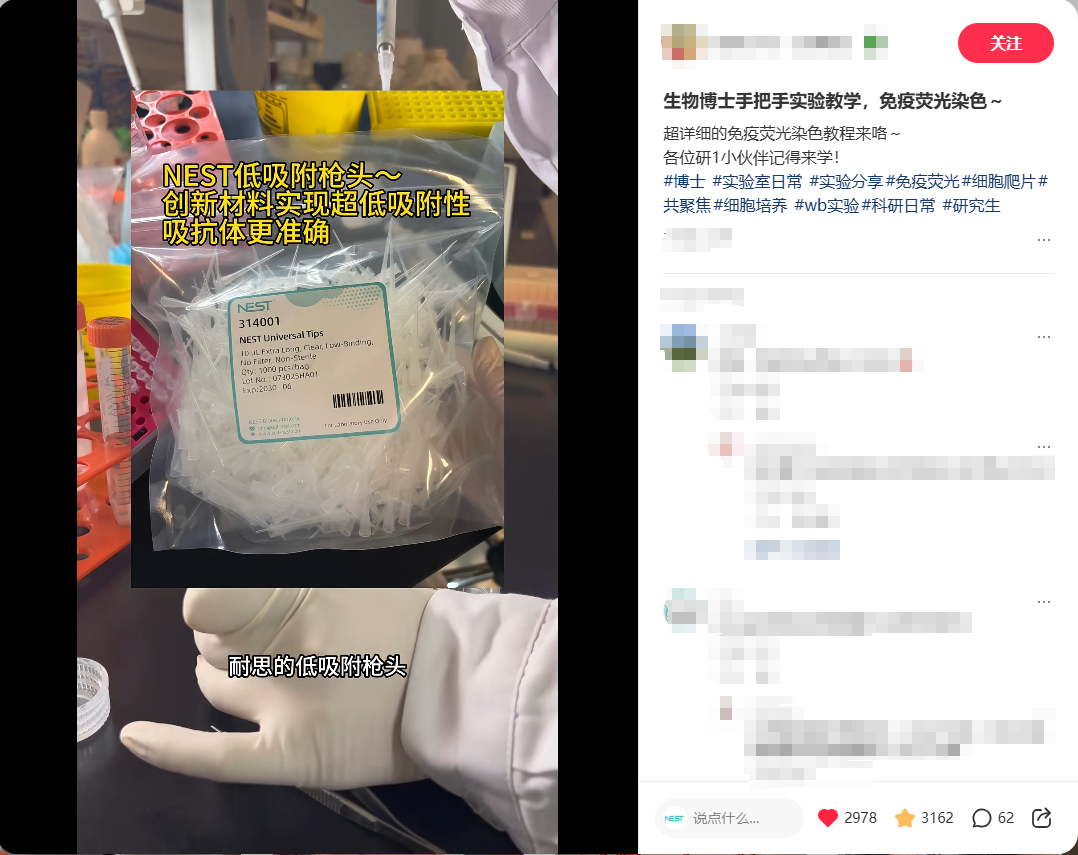
• Significantly Reduced Liquid Residue
The low-binding material minimizes residual liquid during aspiration and dispensing. Even sticky reagents can be dispensed smoothly, ensuring maximum sample recovery and reducing waste of valuable reagents.
• Higher Experimental Reproducibility
For small-volume operations (1-10μL), low-binding tips deliver greater precision and consistency, providing more stable and reliable data. They are especially suitable for qPCR, enzymatic assays, and protein quantification, where strict volume accuracy is required.
• Easier Small-Volume Handling
For precious or expensive samples, low-binding tips effectively reduce “invisible loss,” making every aspiration more reliable, improving efficiency, and reducing manual operation errors.
• Wide Compatibility and Applications
Whether for routine pipetting, cell culture, molecular biology, or high-precision quantitative analysis, low-binding tips consistently deliver high performance and improve overall laboratory data quality.
• Core Advantages
Innovative material technology delivers ultra-low adsorption for sample integrity.
High-precision molding ensures excellent pipetting accuracy.
Compatible with major pipette brands.
Protein Adsorption Test
NEST conducted three rounds of protein adsorption testing using regular tips, three other brands of low-binding tips, and our self-developed low-binding tips. Results showed that NEST low-binding tips had the lowest protein adsorption compared with both regular tips and other brand low-binding tips.
Multiple experiments and evaluations indicate that the material of low-binding tips features reduced adsorption, lower surface tension, and significantly decreased liquid adhesion, minimizing sample loss to the greatest extent. In key applications involving proteins and nucleic acids, low-binding tips help maintain sample stability and prevent fluctuations caused by consumable-related issues.
Feedback from professional laboratories and scientific content creators consistently highlights that low-binding tips provide clear benefits in precision experiments:
• Improved data consistency – significantly enhanced experimental reproducibility
• Reduced sample loss – better recovery of precious reagents
• Higher operation efficiency – fewer repeated steps caused by sample residue
This feedback not only validates the product’s performance but also demonstrates the practical value of low-binding tips in laboratory workflows.