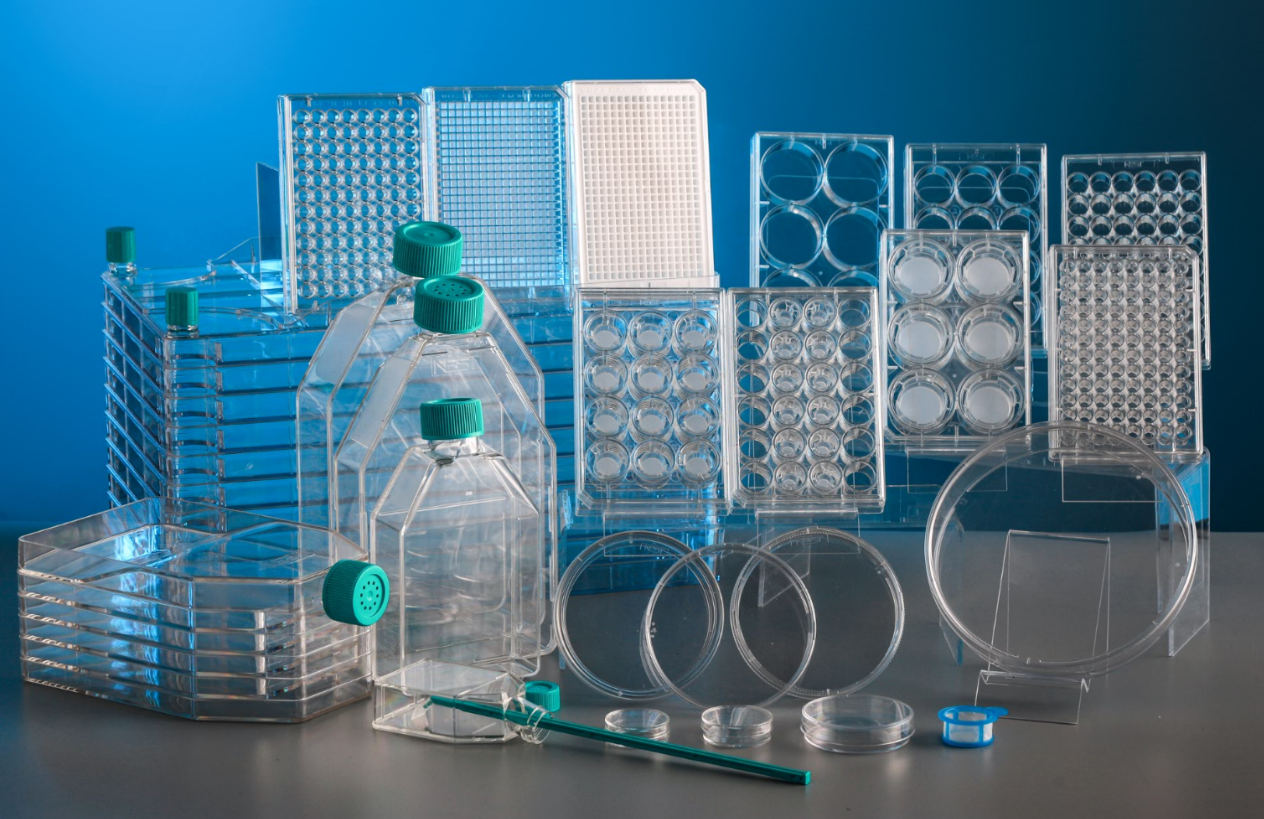
NEST has launched more than ten GelNest™ Matrix products, widely applicable to organoid culture, angiogenesis assays, cell invasion (Transwell) assays, PDX/CDX models, PDO tumor sphere culture, tumor transplantation and subcutaneous tumorigenicity assays, as well as stem cell culture, differentiation studies, and other developing applications—supporting customers across organoid research workflows.
01 What is Matrigel?
Matrigel is a 3D gel-like basement membrane matrix derived from mouse Engelbreth-Holm-Swarm (EHS) tumors. It mainly contains: Laminin-provides adhesion sites, Collagen IV-core structural component of the basement membrane, Entactin/Nidogen-stabilizes the ECM network, Heparan sulfate proteoglycans-involved in signaling, Multiple growth factors (e.g., EGF, TGF-β, FGF) -regulate cell proliferation, differentiation, and migration.
Together, these components form a highly biomimetic extracellular matrix (ECM) that significantly enhances the physiological relevance of tumor cells.
02 Why Does Matrigel Significantly Enhance Tumorigenicity?
1. Matrigel provides a three-dimensional scaffold that supports spheroid formation and stabilizes cell aggregates. In tumorigenicity assays, cells need a 3D environment to form structured clusters, and the ECM offers adhesion sites to promote assembly. The gel-like matrix prevents spheroids from dispersing, enabling tighter, more physiologically relevant tumor spheroids or organoids.
2. Matrigel also delivers biochemical signals that regulate proliferation, cell-cell interactions, invasion, stemness, and drug responses. Components like laminin, EGF, and FGF directly influence adhesion, polarization, and spheroid growth. Consistent batch quality is therefore essential for reproducible results.
3. Moreover, Matrigel mimics the in vivo tumor microenvironment. Its ECM and growth factors provide structural support and signaling cues, affecting adhesion, matrix degradation, invasion, and cell behavior. Thus, Matrigel is not just a gel, but a key factor in achieving biologically relevant tumor models.
03 Effects of Matrigel on Different Tumorigenicity Models
For subcutaneous tumor formation (in vivo xenografts), mixing Matrigel with cells can significantly improve early engraftment efficiency, tumor growth rate, tumor volume consistency, and reduce variability between animals, especially in immunodeficient mice.
In 3D tumor spheroid or organoid culture (in vitro), Matrigel acts as the “infrastructure” of 3D cell culture. It allows cells to form 3D tissue structures, mimics tumor heterogeneity, enhances the reliability of drug screening, and helps maintain stemness (e.g., in cancer stem cell models). This makes it a core material for researchers transitioning from 2D to 3D cultures.
For invasion and migration models (Transwell + ECM), Matrigel can simulate the basement membrane, allowing assessment of cell invasion, matrix degradation, and EMT changes. The thickness and concentration of Matrigel directly influence experimental readouts.
04 Advantages of NEST GelNest™ Matrix
GelNest™ Matrix quality surpasses international standards.
▷ Prepared from basement membrane components extracted from mouse tumor tissue, mainly including laminin, type IV collagen, heparan sulfate proteoglycans, and other ECM proteins.
▷ Rich in growth factors that promote cell differentiation, proliferation, and migration.
▷ Can mimic the basement membrane in physiological environments, improving the success rate and effectiveness of cell culture.
▷ GelNest™ Matrix has clear internal quality control standards, with low-endotoxin versions <1.5 EU and regular versions <4 EU.