Matrigel Tumor Formation Assay
In tumor research, the tumor formation assay is a key experimental method. High-concentration matrigel plays an important role by providing extracellular matrix support, promoting tumor cell growth and formation, and maintaining in situ tumor development. Observing tumors in situ allows real-time monitoring of tumor dynamics, including growth rate, invasiveness, and response to treatments. Using high-concentration Matrigel closely mimics in vivo tumor growth, offering a more physiologically relevant model compared to in vitro experiments, and enabling studies on tumor biology and therapeutic efficacy.
NEST has launched more than ten GelNest™ Matrix products, which are widely applicable for organoid culture, angiogenesis assays, cell invasion (transwell) assays, PDX and CDX models, tumor spheroid (PDO) culture, tumor transplantation, subcutaneous tumor formation, stem cell culture and differentiation studies, as well as other emerging experimental applications. These products support researchers in successfully establishing organoid models and related studies.
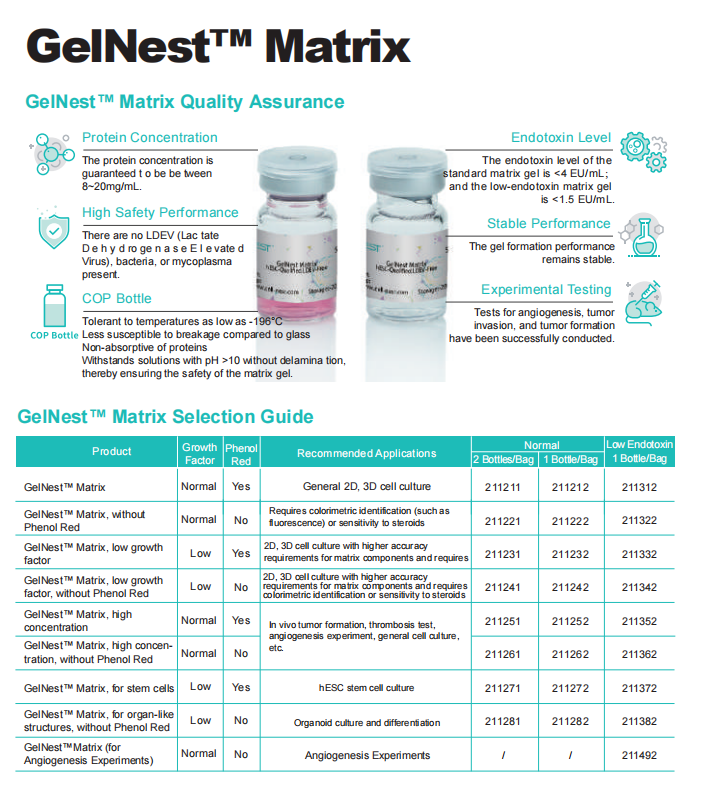
01 Recommended GelNest™ Matrix Products
02 Core Advantages of GelNest™ Matrix
1. Superior Quality Beyond International Standards
▷ Prepared from basement membrane components extracted from mouse tumor tissue, primarily including laminin, type IV collagen, and heparan sulfate proteoglycans.
▷ Rich in various growth factors that promote cell differentiation, proliferation, and migration.
▷ Mimics the characteristics of the physiological basement membrane, improving the success rate and effectiveness of cell culture.
2. Clear Internal Control Standards
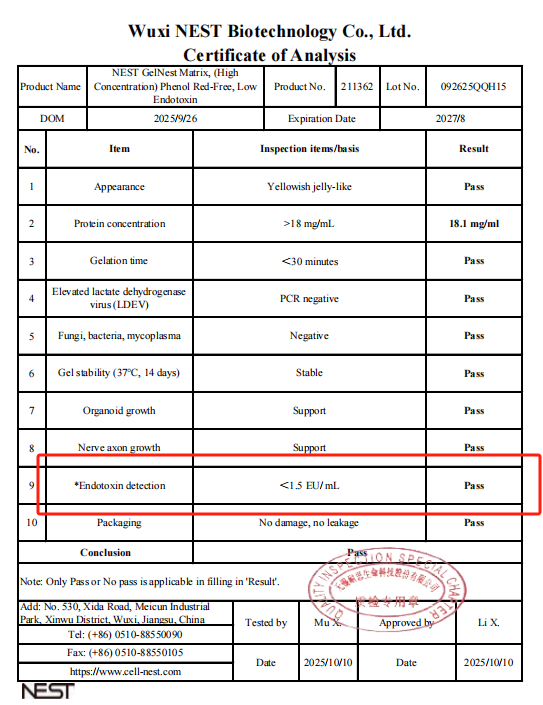
▷ Low endotoxin version: < 1.5 EU
▷ Regular version: < 4 EU
03 GelNest™ Matrix Usage and Storage Guide
1. How to Thaw GelNest™ Matrix
• Take out a 5 mL vial of GelNest™ Matrix and place it in an ice-water bath. Use crushed ice, press it firmly, and insert the vial upright into the ice. Add water until the water level is above the liquid level of the Matrigel. Do not let the bottle cap touch the water surface.
• Then transfer the ice-water mixture containing the vial to a 4 °C refrigerator and leave it overnight (approximately 16 hours) to achieve complete liquefaction.
2. How to Aliquot and Store GelNest™ Matrix
• Prepare a box of 1000 µL sterile pipette tips and several sterile 1.5 mL microcentrifuge tubes. Place them in a pre-chilled ice box or tube rack.
• Before aliquoting, pre-cool all the above consumables in a −20 °C freezer for at least one hour to prevent premature gelation caused by heat exposure.
• Gently mix the Matrigel before aliquoting. Fully thawed GelNest™ Matrix should be a homogeneous liquid without visible clumps.
• Dispense the well-mixed Matrigel into 1.5 mL microcentrifuge tubes.
• Store the aliquoted tubes at −20 °C or −80 °C (for long-term storage).
3. Storage and Handling Precautions
• Before aliquoting, GelNest™ Matrigel can be stored at −20 °C.
• For first-time use, thaw and aliquot according to single-use volumes, then store at −80 °C for up to 2 years. (Do not store GelNest™ Matrigel in frost-free freezers.)
• Short-term storage at 4 °C should follow the product manual, generally not exceeding 7 days.
• GelNest™ Matrix remains liquid at 4 °C and forms a gel at 37 °C. It begins to solidify at temperatures above 10 °C. Therefore, always operate at low temperatures:
·Use pre-cooled pipettes, tips, and microcentrifuge tubes.
·Keep the entire operation on ice.
04 Empowering Research with GelNest™ Matrigel and AI
While continuously optimizing product performance and user experience, NEST is also expanding the frontiers of organoid research. Beyond providing high-quality experimental materials, we aim to unlock the full potential of data-driven insights. The GelNest Organoid V3 Model marks a new milestone, elevating organoid AI analysis to a new level of performance, efficiency, and application diversity.
NEST introduces the third-generation large AI model — GelNest Organoid V3, which represents a complete architectural upgrade from the previous versions.
Powered by the YOLOv8 multi-scale detection framework combined with NEST’s proprietary Work Efficient algorithm, this version achieves a new balance between performance and accessibility — enabling smooth operation even on low-spec computers without dedicated GPUs, while delivering a 3–10× performance boost and significantly improved accuracy.